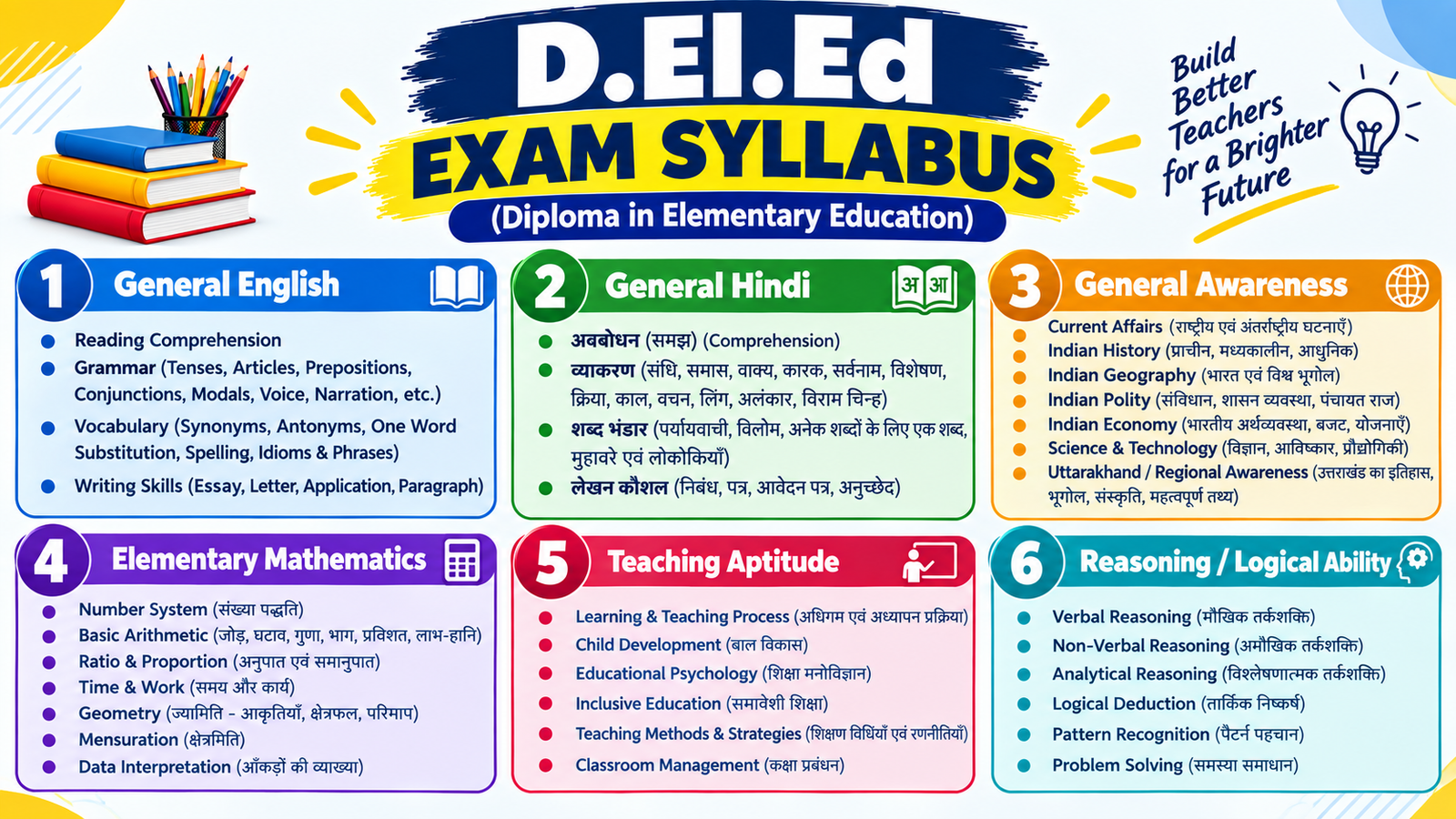
D.El.Ed Exam Syllabus Explained: Subjects, Topics & Preparation Strategy
If you are planning to pursue D.El.Ed (Diploma in Elementary Education), understanding the syllabus should be your first step before starting serious preparation. Whether you are preparing for a D.El.Ed entrance examination or studying the two-year teacher-education programme, knowing the subjects, important topics, exam pattern, and preparation strategy can make your study plan much more focused.
The D.El.Ed syllabus is not exactly identical across every Indian state. State examination authorities and affiliating bodies can prescribe their own entrance-test syllabus and academic structure. At the national level, the National Council for Teacher Education (NCTE) provides the regulatory framework for D.El.Ed programmes, while states may contextualize the curriculum according to their requirements.
For example, the Uttarakhand Board of School Education (UBSE) currently publishes a separate D.El.Ed Entrance Exam Syllabus and a D.El.Ed Entrance Exam 2026 notification.
This guide explains the D.El.Ed exam syllabus in simple language, covers the major subject areas, discusses the topics you should focus on, and provides a practical preparation strategy.
What Is D.El.Ed?
D.El.Ed stands for Diploma in Elementary Education. It is a teacher-education programme designed to prepare candidates for teaching at the elementary level.
The programme focuses not only on academic subjects but also on understanding children, learning processes, teaching methods, classroom management, assessment, and the broader social context of education.
According to NCTE’s regulatory framework, the D.El.Ed curriculum integrates areas such as childhood studies, social context of education, subject knowledge, pedagogical knowledge, educational aims, communication skills, practicum, and school internship. ICT, gender, yoga education, and inclusive/disability education are also identified as integral parts of the curriculum.
Therefore, students should not think of D.El.Ed preparation as simply memorizing school-level facts. A strong understanding of education, child development, teaching-learning processes, languages, mathematics, environmental studies, and social sciences can be valuable.
D.El.Ed Entrance Exam vs D.El.Ed Course Syllabus
Before discussing subjects, it is important to understand a common point of confusion.
There are generally two different meanings when people search for “D.El.Ed syllabus.”
1. D.El.Ed Entrance Exam Syllabus
This is the syllabus for the admission examination conducted by a particular state or authority.
It may include subjects such as:
- General Knowledge
- General Awareness
- Reasoning
- Teaching Aptitude
- Language
- Mathematics
- Science
- Social Science
- Current Affairs
However, the exact subjects and weightage depend on the conducting authority.
2. D.El.Ed Academic Course Syllabus
This is the syllabus students study after admission into the D.El.Ed programme.
It includes areas related to:
- Child development
- Education and society
- Educational psychology
- Curriculum
- Pedagogy
- Language education
- Mathematics education
- Environmental studies
- Science and social science
- Assessment
- ICT
- Inclusive education
- School internship and practical work
NCTE describes the D.El.Ed curriculum as consisting of theory courses, practicum courses, and comprehensive school internship.
So, always check whether you are preparing for an entrance exam or studying the D.El.Ed programme itself.
D.El.Ed Entrance Exam Syllabus: Major Subjects
The exact entrance syllabus varies by state. Therefore, the following sections should be treated as a general preparation framework, not as a replacement for your state’s official notification.
If you are appearing for a particular state examination, download and check the latest official syllabus before finalizing your study schedule.
1. General Knowledge and General Awareness
General Knowledge is commonly included in competitive entrance examinations, and candidates should prepare both static and current topics where applicable.
Important areas include:
- Indian history
- Indian geography
- Indian polity
- Indian economy
- Indian culture
- Important national events
- Important personalities
- Awards and honours
- Books and authors
- Sports
- National symbols
- Important institutions
- Basic knowledge of the Indian Constitution
- Important government schemes
- Current affairs
For state-level D.El.Ed examinations, state-specific general knowledge can also be important.
For example, candidates applying for a state-specific examination should pay attention to the history, geography, culture, important personalities, administrative structure, and major current events of that state.
Preparation tip
Instead of trying to memorize hundreds of facts at once, divide General Knowledge into small categories and revise them regularly.
A 15–20 minute daily revision session can be more manageable than attempting to study everything immediately before the examination.
2. General Intelligence and Reasoning
Reasoning tests your ability to identify patterns, relationships, sequences, and logical connections.
Important topics can include:
- Number series
- Alphabet series
- Analogy
- Classification
- Coding-decoding
- Blood relations
- Direction sense
- Ranking
- Venn diagrams
- Logical relationships
- Odd one out
- Mathematical reasoning
- Simple puzzles
- Statement-based questions
Example
If a question gives:
2, 4, 8, 16, ?
you need to identify the pattern and determine the next number.
The important thing is not just knowing individual question types. You should develop the ability to recognize patterns quickly.
How to prepare
Start with basic questions and gradually increase difficulty.
A useful progression is:
Concept → Solved Examples → Practice Questions → Timed Practice → Mock Test
This approach helps improve both accuracy and speed.
3. Language and English/Hindi Preparation
Language is another important area in many teacher-education entrance examinations.
Depending on the state, the examination may include Hindi, English, a regional language, or a combination of language-related topics.
Common English topics
- Parts of speech
- Articles
- Tenses
- Subject-verb agreement
- Prepositions
- Conjunctions
- Active and passive voice
- Direct and indirect speech
- Synonyms
- Antonyms
- One-word substitutions
- Idioms and phrases
- Vocabulary
- Sentence correction
- Reading comprehension
Common Hindi topics
- संधि
- समास
- पर्यायवाची शब्द
- विलोम शब्द
- अनेक शब्दों के लिए एक शब्द
- मुहावरे और लोकोक्तियाँ
- वाक्य शुद्धि
- शब्द शुद्धि
- गद्यांश
- व्याकरण
- अलंकार
- उपसर्ग और प्रत्यय
Preparation strategy
Language preparation becomes easier when you combine grammar with reading practice.
Read short articles, editorials, educational material, or quality Hindi/English passages regularly. This can improve vocabulary, comprehension, and sentence awareness simultaneously.
4. Mathematics
Mathematics in D.El.Ed entrance examinations is generally focused on fundamental concepts rather than highly advanced mathematics.
Important areas may include:
- Number system
- Simplification
- Fractions
- Decimals
- Percentage
- Ratio and proportion
- Average
- Profit and loss
- Simple interest
- Time and work
- Time, speed and distance
- Basic algebra
- Geometry
- Mensuration
- Data interpretation
What matters most?
For most basic-level mathematics questions, conceptual clarity and calculation speed are extremely useful.
For example, if you know percentage conversion well, many questions involving profit, loss, discounts, marks, and comparisons become easier.
Smart approach
Create a separate notebook containing:
- Important formulas
- Common shortcuts
- Mistakes from practice questions
- Difficult question types
Revise this notebook regularly rather than repeatedly studying entire chapters.
5. Science
Science preparation generally requires a clear understanding of basic concepts from school-level Physics, Chemistry, and Biology.
Physics topics
You may encounter questions related to:
- Force
- Motion
- Work and energy
- Light
- Sound
- Electricity
- Heat
- Measurements
- Everyday applications of science
Chemistry topics
Focus on:
- Matter
- Elements and compounds
- Acids and bases
- Metals and non-metals
- Physical and chemical changes
- Mixtures
- Common chemical substances
- Everyday chemistry
Biology topics
Important areas include:
- Human body
- Nutrition
- Diseases
- Plants
- Animals
- Cells
- Reproduction
- Environment
- Food chains
- Basic health and hygiene
Preparation tip
Don’t simply memorize scientific definitions.
Try to understand why something happens and how it is applied in everyday life. Conceptual learning makes revision easier and helps you solve unfamiliar questions.
6. Social Science
Social Science can cover several interconnected areas.
History
Important areas may include:
- Ancient India
- Medieval India
- Modern India
- Indian freedom movement
- Important historical personalities
- Major events and movements
Geography
Focus on:
- Physical features of India
- Rivers
- Climate
- Agriculture
- Natural resources
- Soil
- Population
- Industries
- Maps and geographical concepts
Civics and Polity
Prepare topics such as:
- Indian Constitution
- Fundamental Rights
- Fundamental Duties
- Parliament
- President
- Prime Minister
- Judiciary
- State government
- Local government
- Elections
- Democratic institutions
Economics
At the basic level, understand:
- Poverty
- Employment
- Agriculture
- Development
- Money
- Banking
- Markets
- Government programmes
- Basic economic terminology
The goal should be to understand relationships between concepts rather than memorize isolated facts.
D.El.Ed Course Syllabus: Core Academic Areas
If you are already enrolled in D.El.Ed, the syllabus is broader than the entrance examination.
NCTE’s framework states that theory courses include perspectives in education, curriculum and pedagogy, with foundations/perspectives organized around areas such as child studies, contemporary studies, and educational studies.
Let’s look at the major areas.
7. Child Development and Childhood Studies
Understanding children is one of the most important components of elementary teacher education.
Students may study:
- Growth and development
- Physical development
- Cognitive development
- Emotional development
- Social development
- Individual differences
- Personality
- Learning processes
- Intelligence
- Motivation
- Childhood experiences
- Family and social environment
You should understand how children learn at different developmental stages and why individual students may respond differently to the same teaching method.
A future elementary teacher needs more than subject knowledge. The teacher must also understand the learner.
8. Educational Psychology
Educational psychology connects psychological principles with teaching and learning.
Major areas can include:
- Learning theories
- Motivation
- Intelligence
- Memory
- Attention
- Individual differences
- Personality
- Learning difficulties
- Classroom behaviour
- Child-centred learning
The practical purpose is to understand questions such as:
Why does a child struggle with a particular concept?
How can motivation improve classroom participation?
Why do two children learn the same concept at different speeds?
Understanding these questions can make educational psychology much more meaningful.
9. Education and Society
Education does not happen separately from society.
This area can involve topics related to:
- Education and social change
- Equality
- Diversity
- Gender
- Culture
- Community
- Socialization
- Educational opportunities
- Constitutional values
- Contemporary educational issues
The purpose is to help future teachers understand the social environment in which children grow and learn.
10. Language Education and Communication
Teachers need strong communication skills because classroom teaching depends heavily on language.
The curriculum can therefore address:
- Language development
- Listening
- Speaking
- Reading
- Writing
- Communication
- Language acquisition
- Classroom interaction
- Multilingual classrooms
- Language teaching methods
NCTE’s D.El.Ed framework specifically includes language proficiency and communication among the theory-related areas.
For an elementary teacher, this is particularly important because children are developing foundational language skills during the early years of schooling.
11. Mathematics Education and Pedagogy
D.El.Ed students do not only study mathematics; they also learn how to teach mathematics.
This distinction is important.
A mathematics pedagogy course may focus on:
- How children learn mathematics
- Mathematical thinking
- Number concepts
- Problem solving
- Mathematical reasoning
- Use of teaching-learning materials
- Common misconceptions
- Classroom activities
- Assessment of mathematical learning
NCTE identifies mathematics pedagogy for the primary stage as part of the D.El.Ed curriculum.
The objective is to help future teachers turn abstract concepts into understandable learning experiences.
12. Environmental Studies and Pedagogy
Environmental Studies, particularly at the elementary level, connects children’s everyday experiences with concepts related to their surroundings.
Topics may involve:
- Family
- Food
- Water
- Shelter
- Travel
- Plants
- Animals
- Environment
- Community
- Health
- Natural resources
The teaching component can include:
- Observation
- Field activities
- Discussion
- Projects
- Experiments
- Local resources
- Child-centred activities
NCTE’s framework includes pedagogy of environmental studies for the primary stage among compulsory pedagogy areas.
13. Science and Social Science Pedagogy
At the upper-primary level, teacher education can also include pedagogy related to science and social science.
Students learn not simply what to teach but how to teach it effectively.
This can involve:
- Lesson planning
- Demonstration
- Discussion
- Experiments
- Project-based learning
- Inquiry-based learning
- Teaching aids
- Assessment
- Classroom activities
NCTE’s framework provides for optional pedagogy areas including Social Science Education, Language Education, Mathematics Education, and Science Education for the upper-primary stage.
14. ICT and Digital Education
Modern teacher education also recognizes the importance of technology.
ICT-related learning may involve:
- Basic computer knowledge
- Digital learning resources
- Educational technology
- Presentations
- Digital teaching materials
- Online learning
- ICT-supported classroom activities
NCTE identifies ICT as an integral part of the teacher-education curriculum.
The objective is not to turn teachers into technology specialists. Instead, teachers should understand how digital tools can support learning.
15. Inclusive Education
Inclusive education is another important area.
Teachers may need to understand:
- Diversity among learners
- Children with disabilities
- Learning difficulties
- Classroom inclusion
- Equal learning opportunities
- Adapted teaching strategies
- Inclusive classroom practices
NCTE explicitly identifies disability/inclusive education as an integral component of the curriculum.
A classroom may contain students with different learning speeds, backgrounds, abilities, languages, and educational needs. Teacher preparation therefore needs to address this diversity.
16. Assessment and Evaluation
Assessment is much more than conducting examinations.
D.El.Ed students may study:
- Formative assessment
- Summative assessment
- Continuous assessment
- Tests
- Observation
- Feedback
- Question-paper construction
- Evaluation techniques
- Learning outcomes
A good assessment should help the teacher understand what students have learned and where they need additional support.
This is why assessment is closely connected to teaching rather than being treated as a separate activity.
17. Practicum and School Internship
One of the most important differences between D.El.Ed and a purely theoretical course is practical teacher training.
NCTE’s framework includes practicum courses and comprehensive school internship, and the broader teacher-education framework emphasizes school-based activities and internship.
During practical training, students may work on:
- Lesson plans
- Classroom observation
- Teaching practice
- School activities
- Student assessment
- Teaching-learning materials
- Community-related activities
- Reflective assignments
This component helps students connect educational theories with actual classroom situations.
D.El.Ed Preparation Strategy for Entrance Exams
Once you understand the syllabus, the next question is: How should you prepare?
A good strategy does not require studying for 10–12 hours every day. It requires consistency, prioritization, and regular testing.
Step 1: Download the Official Syllabus
Start with the syllabus issued by your state’s official examination authority.
Do not depend completely on generic websites because D.El.Ed entrance examinations can differ between states.
For example, UBSE currently maintains an official page specifically for the D.El.Ed Entrance Exam Syllabus.
Create a checklist from the official syllabus and mark every topic as:
- Not Started
- In Progress
- Completed
- Revised
This simple system can prevent important topics from being forgotten.
Step 2: Build Strong Basics
Start with school-level textbooks and basic study material.
Do not immediately jump into difficult competitive-exam books.
For Mathematics and Science especially, make sure your fundamentals are clear before moving to advanced practice.
The same principle applies to grammar and reasoning.
Step 3: Create a Weekly Study Plan
A practical weekly plan could look like this:
| Subject | Suggested Focus |
|---|---|
| Mathematics | Concepts + Practice |
| Reasoning | Questions + Speed |
| Language | Grammar + Comprehension |
| General Knowledge | Static GK + Revision |
| Science | Conceptual Study |
| Social Science | Facts + Understanding |
| Current Affairs | Daily/Weekly Revision |
| Mock Tests | Weekly |
You can adjust the time allocation according to the official syllabus and your personal strengths.
Step 4: Practice Previous Questions
Previous-year questions are extremely useful because they show you the level and style of questions that the examination has used.
While solving them, don’t just check whether your answer is correct.
Also ask:
- Why was my answer wrong?
- Did I misunderstand the concept?
- Did I make a calculation mistake?
- Did I spend too much time?
- Was the question based on a topic I haven’t studied?
Maintain a mistake notebook. Revising your mistakes can be more useful than repeatedly solving questions you already know.
Step 5: Take Regular Mock Tests
Mock tests should become an important part of your preparation as the examination approaches.
Initially, focus on accuracy.
Later, introduce time limits.
A useful progression is:
Topic Test → Sectional Test → Full Mock Test → Analysis → Revision
The analysis stage is particularly important.
Taking a mock test without analyzing your mistakes means you may repeat the same errors in the next test.
Step 6: Revise More Than You Think You Need
Competitive examinations involve a large amount of information.
Therefore, one-time study is rarely enough.
A simple revision cycle can be:
First Revision: Within a few days
Second Revision: After one or two weeks
Third Revision: Before the mock-test phase
Final Revision: Close to the examination
Keep your final revision material short and manageable.
Common Mistakes Students Make While Preparing for D.El.Ed
Studying Without Checking the Official Syllabus
This can lead to wasted time.
Always start with the official syllabus and examination notification.
Collecting Too Many Books
More books do not automatically mean better preparation.
Choose reliable study material and complete it properly.
Ignoring Weak Subjects
Students often spend most of their time on subjects they already like.
Instead, identify your weakest areas and give them consistent attention.
Not Practicing Questions
Reading theory alone is insufficient for an entrance examination.
Regular question practice improves speed and accuracy.
Ignoring Revision
Students sometimes finish chapters and never return to them.
Revision should be part of your original timetable, not something added at the end.
Taking Mock Tests Too Late
Don’t wait until the final weeks to discover that you cannot complete the paper within the available time.
Introduce timed practice gradually.
How to Make a 30-Day D.El.Ed Preparation Plan
If you have approximately one month, divide your preparation into four stages.
Days 1–7: Foundation
Focus on:
- Understanding the syllabus
- Basic concepts
- Important formulas
- Grammar fundamentals
- Basic reasoning
- General awareness
Days 8–15: Topic Completion
Cover the remaining important topics.
Start solving topic-wise questions after completing each chapter.
Days 16–23: Intensive Practice
Increase question-solving.
Focus on:
- Previous papers
- Sectional tests
- Weak topics
- Timed practice
- Revision
Days 24–30: Final Revision
During the final week:
- Take full-length mocks
- Revise short notes
- Review mistakes
- Revise formulas
- Review important facts
- Avoid starting large new topics unnecessarily
The exact schedule should be adjusted according to the official examination date and syllabus.
How to Prepare Current Affairs for D.El.Ed
Current affairs preparation does not have to consume hours every day.
Focus on major categories:
- National events
- International events
- Education
- Government schemes
- Awards
- Sports
- Science and technology
- Important appointments
- Books and authors
- Important days
- State-specific events
Make short notes and revise them weekly.
For state-level examinations, don’t ignore state-specific current affairs.
Best Way to Revise the D.El.Ed Syllabus
Use the 3-layer revision method.
Layer 1: Detailed Notes
During your first study, make reasonably detailed notes.
Layer 2: Short Notes
Convert important information into short points.
Layer 3: Rapid Revision
Before the exam, revise only:
- Formulas
- Definitions
- Important facts
- Difficult concepts
- Mistakes
- Frequently forgotten information
This approach prevents the final revision from becoming overwhelming.
D.El.Ed Syllabus: Frequently Asked Questions
Is the D.El.Ed syllabus the same in every state?
No. The exact syllabus and entrance-examination pattern can vary by state and examination authority. NCTE provides national regulatory standards for D.El.Ed, while state or affiliating bodies contextualize their curricula.
Is D.El.Ed a two-year course?
The NCTE-recognized D.El.Ed is structured as a teacher-education programme, and institutions follow the applicable regulatory framework and affiliating-body requirements. Always check the current notification or prospectus of your specific institution or state authority.
Which subjects should I study for the D.El.Ed entrance exam?
This depends on the state. Common preparation areas can include language, mathematics, reasoning, general knowledge, science, social science, teaching aptitude, and current affairs, but you should confirm the exact subjects from the latest official notification.
Is the D.El.Ed course only theoretical?
No. The curriculum includes theory, practicum, and school internship.
Is pedagogy important in D.El.Ed?
Yes. Pedagogy is a major part of teacher preparation. NCTE’s framework includes pedagogy related to language, mathematics, environmental studies and other curriculum areas.
Should I study current affairs for D.El.Ed entrance exams?
If current affairs are included in your state’s official entrance syllabus, yes. The amount of preparation should be based on the official examination pattern.
Final Preparation Checklist for D.El.Ed Aspirants
Before the examination, make sure you have:
- Downloaded the latest official syllabus
- Completed the major subjects
- Covered basic concepts
- Practiced previous-year questions
- Created short revision notes
- Revised formulas and important facts
- Practiced language questions
- Solved reasoning questions regularly
- Taken full-length mock tests
- Analyzed mistakes
- Revised weak topics
- Checked the latest official examination notification
The official source should always be your final reference for dates, syllabus changes, eligibility, examination pattern, and other admission-related information. NCTE maintains the national regulatory framework, while state authorities publish their own examination information.
Conclusion
The D.El.Ed exam syllabus becomes much easier to manage when you divide it into clear sections instead of trying to study everything at once. For an entrance examination, concentrate on the subjects and topics listed by your particular state authority. For the D.El.Ed academic programme, develop a broader understanding of child development, educational psychology, pedagogy, language, mathematics, EVS, science, social science, ICT, inclusive education, assessment, practicum, and school internship.
The most effective preparation strategy is simple: understand the syllabus, build your basics, practice questions, revise regularly, and analyze mock tests. Consistency is more valuable than studying randomly for long hours.
If you’re preparing for a specific state such as Uttarakhand, Uttar Pradesh, Bihar, Rajasthan, or another state, the next useful step is to create a state-specific D.El.Ed syllabus + exam pattern + 30-day study plan based on its latest official notification.